Ballet on a Budget: How Adult Dancers Can Save Money
I don't know about you, but where I live, the cost of everything has gone up. And ballet is no exception. Classes are more expensive, dancewear is more expensive, and pointe shoes... don't even get me started. 😅
If you've ever done the mental math on what ballet is costing you and felt a little nauseous, you're not alone! So today I want to share my favorite stategies for saving money in creative ways — the tips I actually use, not vague budgeting advice that doesn't hold up in real life. (And, if you prefer to listen instead of read, you can get all if this information in my podcast episode below.) 😄
Let's get into it!
1. Stop thinking of YouTube classes as the "budget option"
A lot of dancers think of YouTube as something you settle for when you can't afford the real thing. I want to challenge that completely.
YouTube classes, when used intentionally, can be a legitimate and powerful part of your training. The free content available today is actually amazing — full-length barre and center classes from qualified, educated teachers. There are channels built specifically for adult dancers at every level, completely free. Think Kathryn Morgan, Ballet for All, English National Ballet, and a bunch of other teachers who post full classes just because they love it.
The key is to have a plan, don't just pick random videos. Look for a teacher whose style and cueing resonates with you, then build a little library of classes you love and use them consistently. Think of it as your personal home studio.
Here's how to make it work really well: Use your in-person classes or private lessons to get specific feedback, identify what you need to work on, and then take that back to your YouTube practice. Your YouTube classes become the place where you actually implement what your teacher corrected. Real feedback plus free repetition is a super effective combination.
2. Make every dollar of studio class go further
Buy packages, not drop-ins. Drop-in rates are almost always a studio's most expensive per-class option, so if you know you'll be there regularly, ask about packages or memberships. The cost per class usually drops significantly once you commit up front, and monthly unlimited memberships can work out to a fraction of the drop-in price depending on how often you go.
Also ask about discounts that aren't advertised. Referral credits, annual memberships, work-exchange programs where you help at the front desk in exchange for class credit... These deals exist at a lot of studios, they just aren't promoted. (And hey, the worst anyone can say is no!) 🤷🏻♀️
It's also good to think about timing your purchases with promotions. Studios tend to run sales around the same windows every year (the new year, back to school, the holidays). If you know you're buying a package anyway, wait for one windows of those if your studio runs promos.
3. Rethink how you use private lessons
Private lessons can feel like a luxury, but I actually think they're one of the most cost-effective investments you can make if you use them the right way.
Instead of taking regular weekly privates, think of them as checkpoints. Take one when you have specific things you want feedback on, get every ounce of information out of that session, then go practice everything you learned until you're ready for the next one.
And ask about 30-minute sessions! A lot of dancers don't even realize these are an option. If you come in focused and warmed up, you can accomplish A LOT in 30 minutes. In my experience, 30 minutes where I show up prepared and hyper-focused is more productive than an hour of generic feedback.
4. Shop secondhand for your dancewear
This is definitely my most-used money-saving strategy and I will probably never stop talking about it. Before you buy any leotard, wrap skirt, or warm-up piece at full price, check secondhand first.
My favorite place for this is Tutulist.com, a dedicated secondhand dancewear marketplace online. We're talking $100 leotards for $20, great condition, many barely worn. More than half of my ballet wardrobe is from there (no lie) and I recommend it to everyone I know. And, you can also sell there! Clear out pieces you're not using, make a little money back, and let someone else enjoy them. So much more satisfying than dropping something at a thrift store where it's unlikely to find a dancer who'll actually wear it.
And one more dancewear idea that's too underused in the adult ballet community...
Organize a clothing swap! Everyone brings pieces they don't love anymore and you trade. It costs nothing, you get something new to you, and it's fun girl time.
We did one at the adult ballet intensive I went to last summer and everyone loved it.
5. Extend the life of what you already own
Replacing things less often is just as good as finding them cheaper (arguably better if you're eco-conscious). 🌎
For ballet slippers: Swap them between feet as soon as you notice one part wearing out faster than the others (usually in the big-toe area). Most slippers don't have a dedicated right and left the way street shoes do, so this can extend their life by allowing them to wear out a bit more evenly!
For pointe shoes: Jet Glue on the shank when it starts to soften absolutely works and has been a ballet-community staple forever — just know it's a preventative measure, not a resurrection for truly dead shoes. If one shoe breaks down faster (usually your dominant foot), you can glue just that one to even out the pair's lifespan (I always have to glue my right shoe first). 🙃
Rotating between two pairs also helps a lot so you let each pair dry out fully between uses (ideally 48 hrs) since sweat is one of the main things that breaks shoes down from the inside out.
Dancers who alternate pairs can get 1.5 to 2 times more life out of their pointe shoes, compared to wearing one pair constantly.
And don't forget to take your shoes out of your bag after every class so they can air out. Another a simple thing that makes a real difference!
For tights: The second you get a small run, stop it with a tiny dot of clear nail polish on each end. Or, if a run is below the knee or just above, you can also cut them into shorts instead of trashing them (cut-off tights are one of my favorite looks for summer). ☀️
For dancewear: Wash your leos, skirts, etc. in room temp or lukewarm water in a mesh laundry bag and AIR DRY ONLY. Heat is the enemy of spandex and elastic — it breaks down the fibers and causes things to lose shape and fade much faster. A few extra minutes of care means your pieces last longer, which saves you money over time.
6. Consider a skill trade
If you have a professional skill (graphic design, photography, web development, social media, bookkeeping, anything!) it's absolutely worth asking your studio if they'd be open to a trade. Studios are small businesses and most of them need those kinds of services. A skill trade for class credit is a win-win, and it happens more than you'd think. I did this with a local studio and provided photography coverage of their recitals in exchange for unlimited salsa classes for me & my husband! 💃🏻
7. Use rewards programs
If you order dancewear or shoes online regularly, make sure you're doing it through a site where you earn rewards. DanceSupplies.com has a points system, and I regularly get $10-25 off my pointe shoes this way. Check if your local dance store has a loyalty or referral program too! Mine does, and those little discounts add up. over a year. 💸
8. Build a ballet budget
This last one is less about saving money in the moment and more about making the money you spend feel sustainable long term.
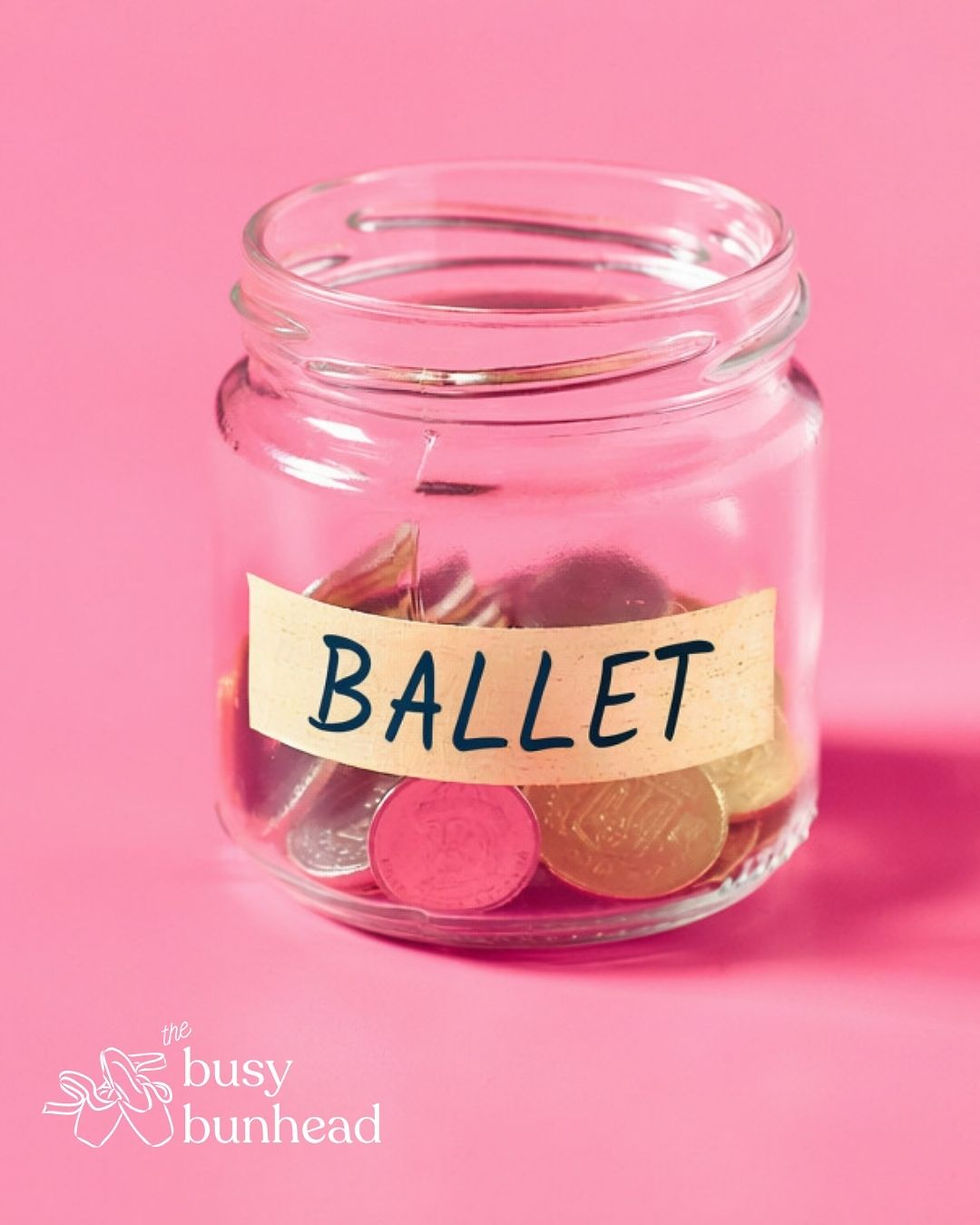
Here's a question: Do you know how much you spend on ballet every month? Not a rough guess... Do you actually know? If the answer is no, you're not alone. Most of us just spend as we go and then have a small internal crisis when our class pass runs out or our pointe shoes die and we suddenly have to drop $130 we weren't expecting.
The fix is simple, even if it takes a little effort upfront. Track everything you spend on ballet for a month or two (classes, shoes, dancewear, subscriptions, extras). Then break it into two categories: your regular monthly costs (things like class packages & streaming platforms) and your irregular costs like pointe shoes, new gear, and recital fees that don't hit every month but definitely hit eventually.
For the irregular costs, here's the trick: Take your best estimate of what you spend on them in a year, divide by 12, and add that amount to your monthly ballet budget as a line item. Set it aside each month into a dedicated savings bucket. A lot of banks and budgeting apps let you create named sub-accounts or envelopes for exactly this. Label it "ballet fund." Then when your pointe shoes die, the money is already sitting there. You're not scrambling, you're not putting it on a credit card, you're not choosing between ballet and something else. You're just using funds you already designated.
It completely changes your relationship with spending money on your hobby. Instead of guilt or stress, you feel organized and in control.
Ballet stops feeling like an indulgence you have to justify and starts feeling like the intentional, worthwhile investment in yourself that it actually is. 😌
This approach also opens the door to saving for bigger goals, and I specifically want to mention adult ballet retreats here because I think a lot of dancers write them off as something they could never afford. But if you add a retreat as a line item in your budget, something that feels like a pipe dream starts to become attainable. A year of saving $150 a month is $1,800. That could cover registration and then some, depending on your itensive of choice.
The main thing I hope you take with you? Ballet doesn't have to be as expensive as it sometimes feels. There are ways to train consistently, train well, and not blow your entire budget doing it.
If you try any of these, I would love to hear about it! Come find me on Instagram @thebusybunhead and let me know what worked for you. And if you want more of this kind of content in your inbox, you can sign up for my newsletter at thebusybunhead.com. 💌
xx, Hannah


Comments